Korean Ad Claim Rules for Cosmetics, Supplements and Food (2026)
Which words get a beauty, supplement or food ad in trouble in Korea: the three laws behind them, prohibited vs safer wording, prior review for health functional food, and a free checker that highlights risky phrases.
Korea is one of the strictest markets for what a beauty, supplement or food ad may say. A cream that “regenerates skin”, a juice that “boosts immunity” or a pill “like a prescription, without one” is not just weak copy there: it can break a law with prison terms attached.
This guide collects the three laws behind those rules, with the exact articles (read on 19 November 2026 on the National Law Information Center, law.go.kr), examples of prohibited and safer wording, and how health functional food ads are reviewed before they run. We also built a free ad claim checker that highlights risky phrases in your copy and names the law each one runs into.
The short version:
- No disease claims for food, supplements or cosmetics: “prevents diabetes”, “cures insomnia”, “treats atopic skin”.
- Nothing that reads like medicine: drug comparisons, “without a prescription”, injection comparisons, “regeneration”, “anti-inflammatory”.
- Functional claims need registration: whitening, wrinkle care and sun protection only for registered functional cosmetics; health functions only for approved health functional food, in the approved wording.
- Superlatives need proof: “No. 1”, “the best”, “no side effects” only with an objective source.
- Health functional food ads need prior review before they run.
The three laws at a glance
| Law | What it bans in ads | Criminal penalty | Source |
|---|---|---|---|
| Act on Labeling and Advertising of Foods, Art. 8(1) | 1: claims that may be taken as preventing or treating disease; 2: food that may be taken as medicine; 3: something that is not health functional food presented as one; also false, exaggerated, deceptive and comparative ads, and ads that skipped the required review (10) | Items 1–3: up to 10 years or 100 million won (Art. 26) | law.go.kr |
| Cosmetics Act, Art. 13(1) | 1: claims that may be taken as medicine; 2: an ordinary cosmetic presented as a functional cosmetic, or claims beyond its review result; 4: other claims that mislead consumers | Up to 1 year or 10 million won (Art. 37) | law.go.kr |
| Fair Labeling and Advertising Act, Art. 3(1) | False or exaggerated, deceptive, unfairly comparative and disparaging ads, for any product | Up to 2 years or 150 million won (Art. 17) | law.go.kr |
Two more articles matter in practice. The Cosmetics Act (Art. 14) and the Fair Labeling and Advertising Act (Art. 5) both say a business must be able to prove the facts it states in an ad. And the food act’s Article 10 requires prior review by a registered self-regulatory body for the ads it covers, which includes health functional food.
The Ministry of Food and Drug Safety (MFDS) gives its own examples of overstated food ad claims: “특효” (miracle effect) and “100% 기능향상” (100% better function), and claims such as anti-cancer effects, hair loss treatment and weight loss that cannot be proven (MFDS).
Prohibited vs safer wording
| Risky wording | Why | Safer direction |
|---|---|---|
| “Prevents diabetes”, “eases constipation”, “for atopic skin” | Disease prevention or treatment (food act Art. 8(1)1) | Remove the disease. For an approved health functional food, use its approved wording, which typically reads “may help …” |
| “Like a prescription diet pill, without the prescription”, “works like a drug” | Food taken as medicine (Art. 8(1)2) | Remove every drug and injection comparison |
| “Boosts immunity” on a juice or snack | Ordinary food presented as health functional food (Art. 8(1)3) | Describe what is in it and how it is made: “cold-pressed from organic apples and kale” |
| “Regenerates skin”, “anti-inflammatory”, “removes scars” | Cosmetic taken as medicine (Cosmetics Act Art. 13(1)1) | Describe cosmetic effects: moisturizing, smoothing, soothing dryness |
| “Wrinkle care”, “whitening”, “blocks UV” without registration | Ordinary cosmetic presented as functional (Art. 13(1)2) | Use them only if the product is a registered functional cosmetic for that function |
| “No. 1 in Korea”, “the best”, “no side effects”, “100% natural” | Needs objective proof (Fair Labeling and Advertising Act Art. 3, 5) | Name the source, period and standard (“No. 1 in juice sales on [store], October 2026, store data”), or remove it |
Reviewers judge the overall impression of an ad, not only single words. A before-and-after photo with a disease name in the caption can mislead even if no sentence says “cure”.
Health functional food: approved wording and prior review
A health functional food (건강기능식품) may state only the functions MFDS approved for its ingredient, in the approved wording. Ordinary food may not borrow those functions at all, because that presents it as health functional food (Art. 8(1)3).
Before a health functional food ad runs, it goes through prior review by the registered self-regulatory body (Art. 10). An ad that skips the review, or changes the copy after approval, is itself a prohibited ad under Article 8(1)10. Build the time for review into the launch plan.
How to use the ad claim checker
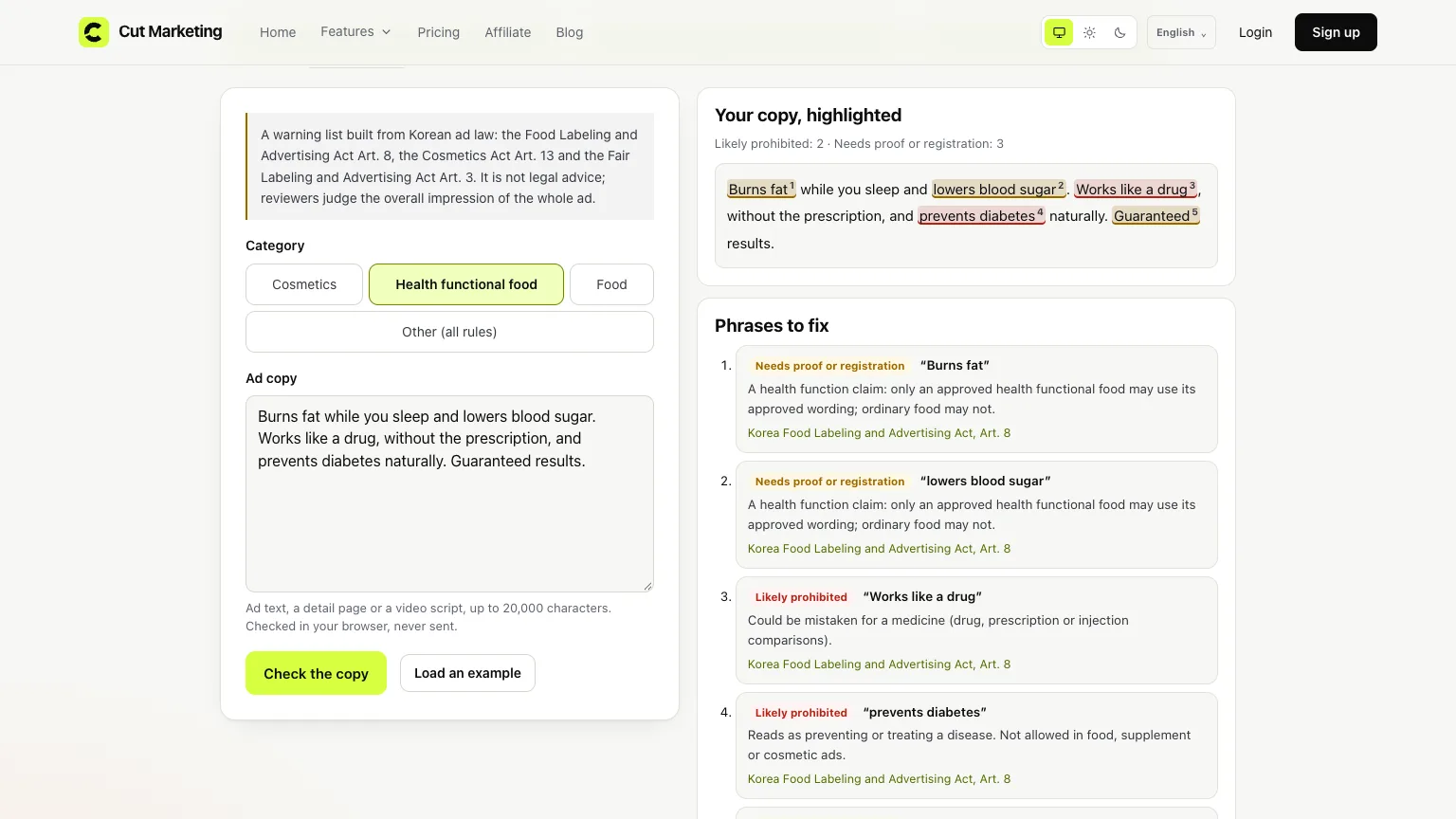
- Paste the ad copy, the detail page text or a video script into the ad claim checker. Korean and English wording are both checked.
- Pick the category: cosmetics, health functional food, food or other. Disease, drug-like and superlative claims are checked in every category.
- The copy comes back with risky phrases highlighted: likely prohibited in red, needs proof or registration in amber.
- Each finding explains the problem and links to the law on law.go.kr.
It runs in your browser and nothing is sent to our server. It is a warning list, not legal advice: check the final ad with the review body or a lawyer.
Make the ad once the copy is clean
When the wording is settled, Cut Marketing turns your product photo and that copy into video ads, images and detail pages, and launches them on Meta, TikTok and Google Ads from one place. Our AI ad copy generator is also instructed not to invent health claims, statistics or unprovable superlatives, so drafts start closer to the rules.
Frequently asked questions
Which Korean laws limit claims in beauty, supplement and food ads?
Three: the Act on Labeling and Advertising of Foods, Article 8 (no disease prevention or treatment claims, no food presented as medicine or as health functional food), the Cosmetics Act, Article 13 (no claims that read as medicine, no functional claims for products that are not registered functional cosmetics) and the Fair Labeling and Advertising Act, Article 3 (no false, exaggerated, deceptive or unfairly comparative ads).
What are the penalties?
Under Article 26 of the food act, a disease, medicine or health-functional-food claim in breach of Article 8(1)1 to 3 can bring up to 10 years in prison or a fine of up to 100 million won. The Cosmetics Act (Article 37) sets up to 1 year or 10 million won for breaching Article 13, and the Fair Labeling and Advertising Act (Article 17) up to 2 years or 150 million won for an unfair ad. Administrative measures such as business suspension can come on top.
Does a health functional food ad need approval before it runs?
Yes. Article 10 of the food act requires prior review by a registered self-regulatory body for the ads it covers, and health functional food ads go through that review. Ads that skip the review or ignore its result are themselves prohibited under Article 8(1)10.
Can a cosmetic say it whitens skin or reduces wrinkles?
Only if it is a functional cosmetic reviewed or reported to the Ministry of Food and Drug Safety for that function. Otherwise the claim makes an ordinary cosmetic look functional, which Article 13(1)2 of the Cosmetics Act bans.
Can I write No. 1 or the best in an ad?
Only with an objective source you can show: who measured it, over what period and by what standard. A business must be able to prove the facts it states in an ad (Fair Labeling and Advertising Act, Article 5).
Does the ad claim checker replace a legal review?
No. It is a free warning list built from the wording of the three laws, and it runs in your browser without sending your copy anywhere. Reviewers judge the overall impression of an ad, so a clean result is not a guarantee.