Check Canonical Tags Before Release
Compare HTML and HTTP canonicals with hreflang and Open Graph URLs. Find unexpected changes before you release a page.
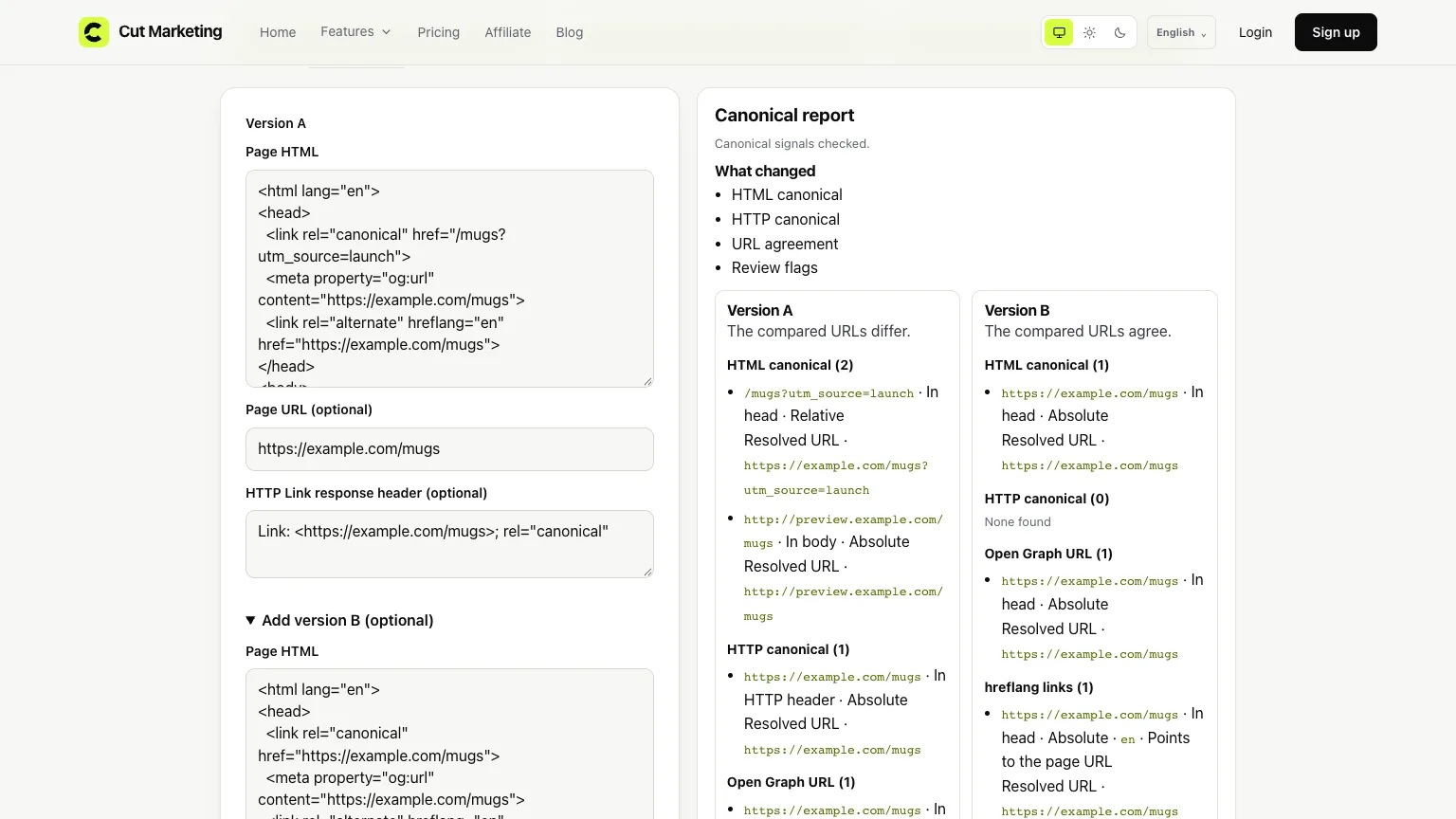
Paste a private draft into Cut Marketing’s canonical tag checker. It checks HTML and response header declarations in your browser and lists the resolved addresses next to the originals. Add a second version and you can see which URL signals changed before you publish.
Check the page you’re about to ship
Use View Page Source to copy the HTML. Include the page URL as it appears in the address bar so relative href values have a base. If you have a Link response header, copy it from the page request under Network in DevTools. Check the HTML and header together. A setting in the server can send its own canonical alongside the one your page template emits.
Google uses rel="canonical" as a strong signal when picking a representative URL for duplicate or very similar pages. It can consolidate signals for the duplicates under that URL. Google accepts the HTML declaration in the head, recommends absolute URLs in both forms and advises leaving out URL fragments. Keep robots.txt for crawl controls. Google may still index a URL blocked there without indexing its content. Google’s canonical URL guide
Review the flags in context
- More than one canonical. Check the theme, plugins and response headers. Google’s examples show how conflicting declarations can make it disregard the hints. A canonical
linkin thebodyis ignored. Google’s common canonical mistakes - Unexpected host, protocol or query. A cross-host or cross-protocol canonical can be intentional. Verify that it points to the preferred version. The checker flags common campaign and click IDs such as
utm_sourceandgclidfor review. Query parameters that identify distinct content may belong in the URL. RFC 6596 - Sharing and language URLs. The Open Graph protocol uses
og:urlas the address of the shared object. Google asks everyhreflangversion to list itself and recommends a canonical in the same language where available. A discrepancy helps you find an old template value or locale path. Open Graph protocol · Google’s localized versions guide · Google’s canonical URL guide - A different canonical alongside
noindex. Review why both declarations are present. Google advises against usingnoindexto steer canonical selection within a site because it excludes the page from Search. Google’s canonical URL guide
Compare staging and production
Paste the second page into version B and use its own page URL and response header. Open the change list first, then compare each affected declaration. A changed host may be expected between environments. An old host or campaign parameter in the production canonical is worth tracing back to the template or server setting that emitted it.
For an indexed production URL, URL Inspection in Search Console shows the canonical Google selected. Use the comparison to trace where the pasted declarations came from. Search Console URL Inspection